Monday, 19 January 2015
Zebra's stripes function like air coolers

WASHINGTON: The distinctive monochrome fur pattern in zebras keep the animals cool under the hot African sun, shows a recent study.

Sunday, 18 January 2015
NASA telescope spies 3 new potentially habitable (and close) planets


NASA’s Kepler telescope has its eye on three new potentially habitable planets. At a distance of 150 light years, the three “lukewarm” bodies are among the closest candidates for habitable life.The star they orbit is known m as EPIC201367065. It’s an M-class dwarf about half the mass and size of our own Sun. It’s a little colder too. But at a trillion-and-a-half kilometers away (930,000,000 miles) it makes the top 10 list of our closest presumably habitable systems.One of the three planets discovered is particularly exciting to scientists, but the rest of our gadgets are still to do their analyzing and the discovery is then to be handed over to the Hubble telescope for a more intricate look."A thin atmosphere made of nitrogen and oxygen has allowed life to thrive on Earth. But nature is full of surprises. Many exoplanets discovered by the Kepler mission are enveloped by thick, hydrogen-rich atmospheres that are probably incompatible with life as we know it," Ian Crossfield of the University of Arizona, who lead the study, said of the January 6 discovery."Most planets we have found to date are scorched. This system is the closest star with lukewarm transiting planets," Erik Petigura, who discovered the planets while analyzing data NASA provided to astronomers, added. Image from wikipedia.org
One of the planets caught Petigura’s attention in particular – the farthermost one, which has a strong chance of being rocky, like Earth. For the space scientist, this “means this planet could have the right temperature to support liquid water oceans.”
What allowed the team to use the telescopes was the relatively close distance. One can say with certainty in these situations that a star’s brightness will give further clues to determining things like similarity to the chemical composition in Earth’s own atmosphere.
From then on, one can make an educated guess if life is possible.
Up next come the more advanced telescopes. The Hubble telescope will soon start establishing the molecular composition of the star’s atmosphere and that of the planets around it.
“If these are warm – nearly Earth-size planets have puffy, hydrogen-rich atmospheres – Hubble will see the telltale signal,” Petigura said.
The paper is reviewed in the Astrophysical Journal.
The Kepler mission is NASA’s finest attempt yet to use cutting-edge technology for photographing and measuring light changes in distant worlds. This data is remarkable in its ability to reveal planetary secrets at distances we can barely imagine.
It took several steps for the confirmation to take place. After Petigura analyzed the light curve data provided by NASA, the scientists set about feeding coordinates into some of the most advanced telescopes – in Chile, Hawaii and California. This allowed them to establish the host star’s radius, mass, temperature and age.
NASA’s Kepler telescope has its eye on three new potentially habitable planets. At a distance of 150 light years, the three “lukewarm” bodies are among the closest candidates for habitable life.The star they orbit is known m as EPIC201367065. It’s an M-class dwarf about half the mass and size of our own Sun. It’s a little colder too. But at a trillion-and-a-half kilometers away (930,000,000 miles) it makes the top 10 list of our closest presumably habitable systems.One of the three planets discovered is particularly exciting to scientists, but the rest of our gadgets are still to do their analyzing and the discovery is then to be handed over to the Hubble telescope for a more intricate look."A thin atmosphere made of nitrogen and oxygen has allowed life to thrive on Earth. But nature is full of surprises. Many exoplanets discovered by the Kepler mission are enveloped by thick, hydrogen-rich atmospheres that are probably incompatible with life as we know it," Ian Crossfield of the University of Arizona, who lead the study, said of the January 6 discovery."Most planets we have found to date are scorched. This system is the closest star with lukewarm transiting planets," Erik Petigura, who discovered the planets while analyzing data NASA provided to astronomers, added.Image from wikipedia.org
One of the planets caught Petigura’s attention in particular – the farthermost one, which has a strong chance of being rocky, like Earth. For the space scientist, this “means this planet could have the right temperature to support liquid water oceans.”
What allowed the team to use the telescopes was the relatively close distance. One can say with certainty in these situations that a star’s brightness will give further clues to determining things like similarity to the chemical composition in Earth’s own atmosphere.
From then on, one can make an educated guess if life is possible.
Up next come the more advanced telescopes. The Hubble telescope will soon start establishing the molecular composition of the star’s atmosphere and that of the planets around it.
“If these are warm – nearly Earth-size planets have puffy, hydrogen-rich atmospheres – Hubble will see the telltale signal,” Petigura said.
The paper is reviewed in the Astrophysical Journal.
The Kepler mission is NASA’s finest attempt yet to use cutting-edge technology for photographing and measuring light changes in distant worlds. This data is remarkable in its ability to reveal planetary secrets at distances we can barely imagine.
It took several steps for the confirmation to take place. After Petigura analyzed the light curve data provided by NASA, the scientists set about feeding coordinates into some of the most advanced telescopes – in Chile, Hawaii and California. This allowed them to establish the host star’s radius, mass, temperature and age.
Saturday, 17 January 2015
2014 Bumi paling PANAS

Tahun lepas adalah Bumi paling panas dalam rekod, mengukuhkan hujah bahawa
manusia telah mengubah iklim planet dengan pembakaran terbuka dan bahan api
gas yang berleluasa, menurut sepasang analisis oleh dua agensi utama AS.
Kajian yang berasingan oleh Nasa, Oceanic Kebangsaan dan Pentadbiran
Atmosfera menunjukkan bahawa dengan pengecualian tahun 1998, 10 tahun paling panas dalam rekod telah berlaku sejak tahun 2000.
Laporan pada awal tahun apabila wakil-wakil kerajaan kira-kira 200 akan bertemu
di Paris untuk berbincang dan bersetuju mengenai perjanjian untuk menghadkan pemanasan global untuk mengelakkan banjir, kemarau, heatwaves dan kenaikan aras laut dipersalahkan kepada peningkatan pengeluaran gas-gas rumah hijau, yang terhasil daripada pembakaran bahan api fosil
seperti arang batu dan minyak.
"Diambil bersama, suhu panas daripada beberapa dekad yang baru-baru ini menunjukkan kesan gas greenhouse di iklim kita, dan membatalkan sound bite bahawa pemanasan global entah bagaimana 'berhenti,'" kata Joe Casola,seorang a staff scientist at the Center for Climate and Energy Solutions.
Sejak tahun 1880, apabila penyimpanan rekod bermula, suhu purata permukaan Bumi telah dihangatkan oleh kira-kira 1.4 darjah Fahrenheit (0.8 darjah Celsius), satu trend yang sebahagian besarnya didorong oleh peningkatan karbon dioksida dan pelepasan manusia lain ke dalam atmosfera planet, kata Nasa.
"Walaupun ranking tahun individu boleh dipengaruhi oleh perubahan cuaca yang huru-hara,
trend jangka panjang adalah berpunca daripada pemacu perubahan iklim yang sekarang dikuasai oleh pelepasan manusia daripada gas-gas rumah hijau," Gavin Schmidt, pengarah Nasa ini Goddard Institut Angkasa kajian di New York, berkata dalam satu kenyataan.Pada tahun 2014 satu siri rekod haba telah rosak di Perancis, Britain, Jerman dan Belgium.Di Perancis, "2014 merupakan tahun yang paling hangat sejak tahun 1900," agensi cuaca Meteo-Perancis berkata, sambil menambah bahawa suhu purata tahunan negara ini pada tahun 2014 adalah 1.2 darjah Celsius (2.2 darjah Fahrenheit) yang lebih tinggi daripada biasa.
Di Britain, data sementara menunjukkan 2014 telah tahun paling panas di negara ini sejak 1910, menurut Pejabat Met. Suhu purata pada tahun 2014 adalah 9.9C, 1.1C melebihi purata 1981-2010.
Average temperature for 2014 higher than 2010: scientists

Temperatures Source: TheAustralian
RECORD temperatures scorched the planet last year, making 2014 the hottest in more than a century and raising new concerns about global warming, US government scientists said.
The much-anticipated report by scientists at the National Oceanic and Atmospheric Administration was confirmed by an independent analysis from the US space agency NASA that reached the same conclusion.
“Record warmth was spread around the world,” said the NOAA report. “The globally averaged temperature over land and ocean surfaces for 2014 was the highest among all years since record keeping began in 1880.”
For the year, the average temperature was 0.69C above the 20th century average, beating the previous record-holding years of 2005 and 2010 by 0.04C.
Parts of the world that saw record heat included Russia, western Alaska, the western United States, parts of interior South America, parts of eastern and western coastal Australia, north Africa and most of Europe.
Record cold for the year was apparent only in some parts of the eastern and central United States.
Experts said the report offers more evidence that humans are driving global warming by burning fossil fuels that boost harmful greenhouse gases in the atmosphere.
“People are always asking, of course, why do we think this is going on,” said Gavin Schmidt, director of NASA’s Goddard Institute for Space Studies in New York.
“The data shows quite clearly that it is the greenhouse gas trends that are responsible for the majority of the (warming) trends that we have actually seen,” he said.
The research group Climate Central said the odds were one in 27 million that the warming trend – in which 13 of the hottest 15 years on record have all occurred since 2000 – could have happened randomly, without human-driven influence on the planet’s temperatures.
“What’s surprising is that anyone is surprised that 2014 was the hottest year on record. The science has been screaming at us for a long, long time,” said Secretary of State John Kerry.
“The question is when and how the world will respond. Ambitious, concrete action is the only path forward that leads anywhere worth going.”
Globally averaged sea surface temperature was the highest ever, at 0.57C above the 20th century average.
Land surface temperature was 1C above the 20th century average, marking the fourth highest in history.
Sea ice continued to decline in the Arctic, depriving polar bears of habitat and driving global warming changes that are felt in distant corners of the world.
The average annual sea ice extent in the Arctic was the sixth smallest in the 36 years that experts have on record.
Meanwhile, sea ice in the Antarctic reached record highs for the second year in a row.
December also broke records, with the highest combined land and ocean average surface temperature for any December in modern history.
“It’s particularly striking that we set a global temperature record,” despite a lower than expected effect from El Nino, an ocean condition that brings warmer weather, said Brenda Ekwurzel, a senior climate scientist at the Union of Concerned Scientists.
“Long-term, we can expect this record to be broken again and again,” she said. Environmentalists said the report should serve as a call to action.
“The record temperatures last year should focus the minds of governments across the world on the scale of the risks that climate change is creating,” said Bob Ward, policy and communications director at the Grantham Research Institute on Climate Change.
He called for an international deal “to strongly reduce greenhouse gas emissions, to be reached at the United Nations climate change summit in Paris in December 2015.”
In the meantime, Schmidt said there are things people can and should do in their everyday lives to turn the tide.
“There are things that people individually can do to reduce their carbon footprint, like having better appliances, driving less, walking more, biking. I try and do those things,” he said.
Friday, 16 January 2015
Cambodian discovery: New legless amphibian species in rainforest

PHNOM PENH, Jan 16 — A new species of legless amphibian resembling a giant earthworm or a snake has been discovered in a remote but threatened area of Cambodian rainforest, conservationists said on today.
The grey-brown creature — Ichthyophis cardamomensis — was found in Cambodia's southwest Cardamom Mountains, an area under threat from habitat loss, according to Fauna and Flora International (FFI).
The new species is often mistaken for a snake, with larger species known to grow up to 1.5 metres (nearly five feet) in length, FFI said.
It was confirmed by scientists earlier this month according to leading Cambodian FFI herpetologist Neang Thy.
“These discoveries are important to demonstrate that much of Cambodia's biodiversity remains unknown and unstudied by science, and many more areas need to be searched,” Thy, who has been researching amphibians and reptiles since 2003, told AFP.
The creature is caecilian — an order of amphibians that look like snakes or earthworms and are generally found underground.
Once a stronghold of the toppled Khmer Rouge regime, the bio-diverse Cardamom Mountains are home to an array of rare species, including the Asian elephant, but the area faces widespread deforestation.
Conservationists warn that illegal logging and other habitat destruction could mean new species become extinct shortly after discovery. — AFP
- See more at: http://www.themalaymailonline.com/features/article/cambodian-discovery-new-legless-amphibian-species-in-rainforest#sthash.8QF4iM63.dpuf
Study:Zebra stripes May Be For Cooling

Indeed, preliminary observations using a digital thermometer gun showed that grazing zebras maintain a significantly lower surface body temperature (84.6 degrees Fahrenheit) than nearby antelopes that are similar in size but have brown coats (90.5 degrees).
There were many theories suggested by scientists regarding zebra stripes, including the stripes evolved to repel insects, confuse predators, provide camouflage through some form of confusing optical illusion, reduce body temperature, or help with social cohesion.
Scientists from the United States and Germany studied 29 different environmental variables in Plains zebras in 16 different sites ranging from south to central Africa.
“Our finding that the two environmental variables most closely associated with variation in striping were both temperature variables lends support to the hypothesis that striping may be related to thermoregulation”, researchers reported.
The new research could not exactly tell the reason behind the stripes. However, it does indicate that temperature is a robust factor to have a relation with striping.
Thursday, 15 January 2015
World's oldest butchering tools aided human language evolution over 2 million yrs ago
Washington: A new study has revealed that world's oldest butchering tools gave evolutionary edge to human communication over 2 million years ago.
Combining the tools of psychology, evolutionary biology and archaeology, scientists from University of California, the University of Liverpool and the University of St. Andrews have found compelling evidence for the co-evolution of early Stone Age slaughtering tools and our ability to communicate and teach, shedding new light on the power of human culture to shape evolution.
The study is the largest to date to look at gene-culture co-evolution in the context of prehistoric Oldowan tools, the oldest-known cutting devices. It suggests communication among our earliest ancestors may be more complex than previously thought, with teaching and perhaps even a primitive proto-language occurring some 1.8 million years ago.
Lead author Thomas Morgan said that their findings suggest that stone tools weren't just a product of human evolution, but actually drove it as well, creating the evolutionary advantage necessary for the development of modern human communication and teaching.
Morgan added that their data show this process was ongoing two and a half million years ago, which allows us to consider a very drawn-out and gradual evolution of the modern human capacity for language and suggests simple "proto-languages" might be older than we previously thought.
The data suggest that when the Oldowan stone-tool industry started, it was most likely not being taught, but communication methods to teach it were developed later.
Morgan said that at some point they reached a threshold level of communication that allowed Acheulean hand axes to start being taught and spread around successfully and that almost certainly involved some sort of teaching and proto-type language.
The study is published in the journal Nature Communications
New program to help robots 'see' better
WASHINGTON: MIT scientists have developed a new algorithm that could enable household robots to better identify objects in cluttered environments.
Researchers believe that the robots should take advantage of their mobility and their relatively static environments to make object recognition easier by imaging objects from multiple perspectives before making judgements about their identity. Matching up the objects depicted in the different images, however, poses computational challenges.
Researchers at the Massachusetts Institute of Technology (MIT) show that a system using an off-the-shelf algorithm to aggregate different perspectives can recognize four times as many objects as one that uses a single perspective, while reducing mis-identifications.

Researchers believe that the robots should take advantage of their mobility and their relatively static environments to make object recognition easier by imaging objects from multiple perspectives before making judgements about their identity. Matching up the objects depicted in the different images, however, poses computational challenges.
Researchers at the Massachusetts Institute of Technology (MIT) show that a system using an off-the-shelf algorithm to aggregate different perspectives can recognize four times as many objects as one that uses a single perspective, while reducing mis-identifications.
Researchers believe that the robots should take advantage of their mobility and their relatively static environments to make object recognition easier by imaging objects from multiple perspectives before making judgements about their identity.
Wednesday, 14 January 2015
Has Europe's Long-Lost Beagle 2 Mars Lander Been Found?
The U.K. Space Agency is holding a news conference Friday about the European Space Agency's Beagle 2 Mars lander, prompting speculation that the probe has finally been found more than 11 years after dropping off the radar at the end of its journey to the Red Planet.
The Beagle 2 was supposed to touch down on Dec. 25, 2003. The lander successfully deployed from ESA's Mars Express orbiter on Dec. 19 of that year, but no touchdown confirmation came, and most experts think Beagle 2 crashed on the Red Planet's surface.
The lineup for Friday's three-hour press event, which will be held in London, suggests that the long search for the lander or its remains may be over.
The speakers include Beagle 2 manager Mark Sims; U.K. Space Agency Chief Executive David Parker; Alvaro Giménez Cañete, ESA's director of science and robotic exploration; and John Bridges, a science team member for NASA's Curiosity rover and Mars Reconnaissance Orbiter.
Bridges works with MRO's High Resolution Imaging Science Experiment, also known as HiRISE, which takes super-sharp pictures of the Martian surface. HiRISE has photographed the Curiosity and Opportunity rovers from space, and it also found NASA's twin Viking landers, which touched down on the Red Planet in 1976.
Friday's event unfolds from 9:15 a.m. to 12:15 p.m. local time (4:15 to 7:15 a.m. ET) at the Royal Society's Kohn Centre in London.
 BEAGLE2.COM / E.K. GIBSON / NASA JSC
Elon Musk, Stephen Hawking warn of artificial intelligence dangers
 Call it preemptive extinction panic, smart people buying into Sci-Fi hype or simply a prudent stance on a possible future issue, but the fear around artificial intelligence is increasingly gaining traction among those with credentials to back up the distress.
The latest example of this AI agita manifesting into real world action comes in the form of an open letter calling for safety measures to be instituted that was posted online Sunday and signed by none other than Tesla's Elon Musk and famed theoretical physicist Stephen Hawking.
Fish gets fake eye to stop bullies
 After the fish had its original eye removed because of cataracts, the medical team was worried it might get attacked.
The Vancouver Aquarium has come to the aid of a fish being potentially bullied because of a disability.
The rockfish underwent special surgery to have a glass eye implanted.
After the fish had its original eye removed because of cataracts, the medical team was worried it might get attacked.
The head veterinarian at the Vancouver Aquarium, Martin Haulena, affixed a special taxidermy eye to the fish while the animal was put under anesthesia.
"We do find when fish are blind from one eye and has no visible eye, other fish recognise that and will kind of attack from that side," Dr Haulena said.
The fish seems to be adapting nicely, according to Dr Haulena.
"The fish is doing really well," he said. "He is highly visible in the habitat and using his environment as would be expected."
SpaceX Continues to Deliver the Goods for America
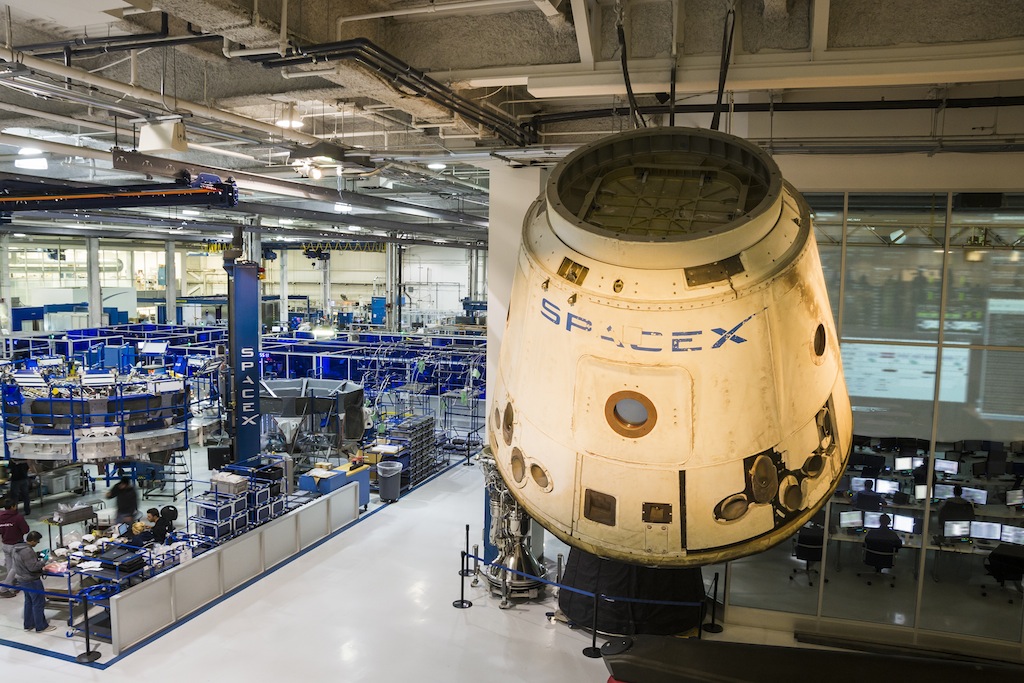
Early Monday morning a SpaceX Dragon capsule docked with the International Space Station (ISS) in a successful commercial resupply mission. Elon Musk's Hawthorne, California firm is now five for five on these missions, not counting two successful test flights. This demonstrated reliability is critically important for continued operation of the space station, which can no longer depend on the Space Shuttle's massive cargo capacity.
ISS can also receive deliveries from Russia's less dependable Progress vehicle as well as from the seldom-used Japanese Kounotori spacecraft. The other American option, Orbital Sciences' Cygnus craft, made two successful flights to ISS before suffering a catastrophic failure last October when the Russian engine in its Antares launch vehicle exploded immediately after take off from its Virginia launch pad. Orbital has decided to replace that engine with a newer Russian model while its spacecraft hitches rides from United Launch Alliance's, Russian powered Atlas V.
SpaceX also has an impressive half dozen commercial launches to its name and a manifest of launch orders from domestic and international clients stretching into the future. They've managed to do this the old fashioned way, by being cheaper, faster and more reliable.
Elon Musk's unlikely startup leveraged existing resources by securing a good deal on a boarded up Northrup-Grumman production facility and hiring from California's deep pool of aerospace talent. I've visited the SpaceX production facility many times over the years and watching it grow has been astoundingly impressive. There was a time when most of the activity in the massive factory was huddled in the corners and workers rode bicycles to get from one end of a mostly empty space to the other. In fact, they had the time and the space to film parts of Iron Man 2 inside that cavernous enclosure. Those days are long gone and you can hardly turn around in the factory without bumping into a spacecraft, rocket engine or one of the thousands of skilled SpaceX workers. The firm is expanding with operations in Texas, Florida and New Mexico and has hundreds of jobs openings posted. Approaching the space market like a consumer products business and building rockets on a rate of production rather than on a custom order basis, this all-American space company has been aggressively driving down costs in a way that even scares the Chinese.
The only truly American option for keeping American astronauts supplied is also the most likely candidate to save them from dependence on Russia for rides to the space station. The Dragon Version 2 is awaiting final tests from NASA to begin its taxi service under the agency's ambitious Commercial Crew program. Ironically, the main reason that hasn't already happened has been a NASA budget strangled by Congress and consumed by expensive payments to Russia. The other NASA candidate for the work, Boeing, has chosen to use the Russian powered Atlas V as its launch vehicle.
Meanwhile, SpaceX moves forward with each launch using an iterative development model, which recognizes that there are ideas which must be flight-tested, and some failures that must be tolerated. In that spirit, last week's launch included an attempt to return the Falcon 9 first stage to a soft landing on a hundred meter robotic platform in the Atlantic Ocean. That added test, while in no way distracting from the NASA contracted mission, was not entirely successful. Despite successfully bringing the 14-story tall first stage down from a high altitude hypersonic flight to the tiny target platform, the stage apparently came in a bit fast and crashed on impact. Photos of the relatively undamaged platform suggest the event was not at all catastrophic.
SpaceX's reason for trying this seemingly crazy stunt wasn't to win an entry in the Guinness Book of World Records, but rather to disrupt the economics of spaceflight by moving launchers from an expendable model to a sustainable and reusable model. This innovation has the potential to reduce launch costs by an order of magnitude and literally to shift human history into a higher gear. SpaceX does this important work on the side while running a profitable business in a field littered with the bodies of previous market entrants.
Given Elon's record at PayPal, Tesla and SpaceX, I would not bet against him succeeding the next time around, or the one after that. He and his whole team are to be congratulated for the work they do, the jobs they provide and the can-do attitude that keeps them experimenting. His growing success suggests we should all reconsider the dominant business paradigm that chases cost savings abroad, disconnects R&D from outsourced production, prioritizes short-term profits over long-term investments and places processes above personalities.
Greg Autry teaches technology entrepreneurship at The Lloyd Greif Center for Entrepreneurial Studies in the Marshall School of Business at the University of Southern California. He recently co-authored a report for the FAA Offices of Commercial Space Transportation entitled An Analysis of the Competitive Advantage of the United States of America in Commercial Human Orbital Spaceflight Markets. You can find him on Facebook.
You Can Now Buy Kurt Cobain’s Suicide Note on a Shirt If You’re Gross Enough to Do That

- People, amirite? At least one of them is responsible for the worst shirt of 2015 so far. It featuresKurt Cobain‘s suicide note blown up and printed on the front. Your move, Urban Outfitters.
- Th original sexy suicide shirt was being hawked via Etsy, though it looks like the store has now taken it down after it came to the attention of a Redditor yesterday. However you can still buy a different version of it — yes, this atrocity comes in two trending styles — on eBay for a cool $25.19. The eBay version is more winter-appropriate, which is about as appropriate as anything glorifying suicide will ever be.
Subscribe to:
Comments (Atom)